


In an era of infinite generative velocity, the ultimate luxury is human curation. We explore why the machine requires a master.
DATELINE: DEC 09, 2025 / THE EDITORIAL / HOUSE INTELLIGENCE
Introduction: The Deluge of Mediocrity
We have breached the dam. The last two years have witnessed the democratization of creation on a scale unprecedented in human history. The barriers to entry for visual art, copy, and video have crumbled into binary dust. We were promised a new Italian Renaissance; what we received instead was a global deluge of mediocrity.
The prompt box has become the new canvas, and millions are painting. The result is an infinite scroll of “good enough”—a relentless stream of synthetically generated content that mimics the aesthetics of quality without understanding its soul. We are drowning in velocity, yet starved for veracity.

At the House of Namus, we have observed a new phenomenon emerging from this digital noise. It is the chasm between what the machine can generate and what the human spirit resonates with.
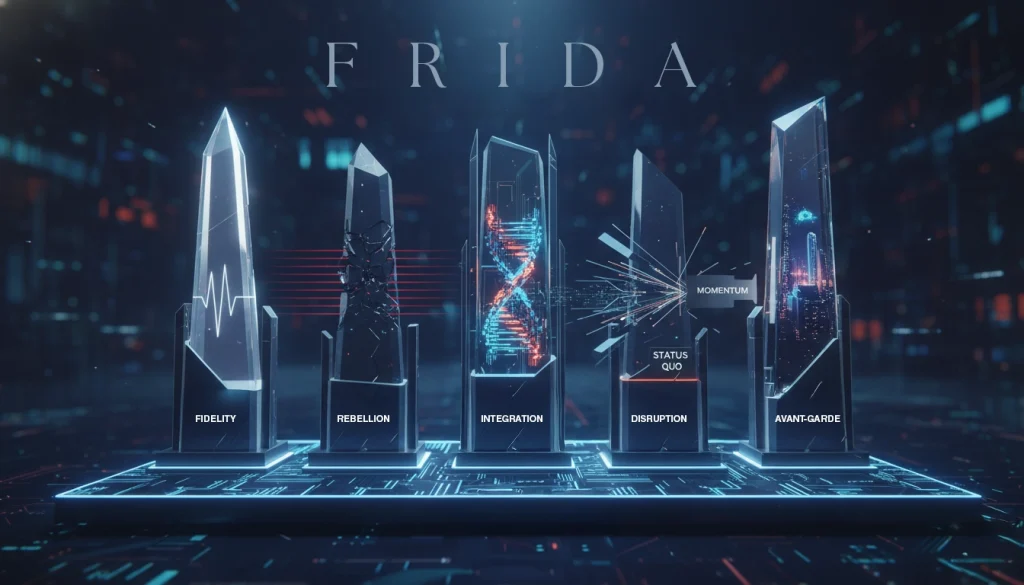
We call this The Fidelity Gap.
Fidelity is not merely high resolution. It is high truth to the brand. It is the unwavering adherence to a strategic standard that an algorithm, by its very nature, cannot comprehend. As AI engines become exponentially faster, this gap does not close; it widens. The market is about to bifurcate into two distinct classes: those who are drowning in synthetic noise, and those who know how to wield high-fidelity signals.
The Engine of Derivative Infinity
To understand the Fidelity Gap, one must understand the fundamental limitation of generative artificial intelligence. These models are magnificent engines of probability. They have ingested the sum total of human digital output and learned to predict the next most likely pixel or word.
They are the ultimate mirrors, reflecting our collective averages back to us at light speed. But a mirror cannot create; it can only reflect.
AI operates on patterns. It knows that a sunset is usually orange, and that luxury is usually sleek. It can generate a thousand variations of a “sophisticated perfume bottle in a marble environment” in the time it takes a human designer to open their sketchbook.
But the machine does not know why marble feels luxurious. It has never felt the cold weight of stone under its fingertips. It does not understand the cultural baggage of a serif font versus a sans-serif one. It mimics the brushstrokes of the masters without understanding the agony or the intent that guided the hand.
The machine gives you options. It does not give you answers. It provides speed, but speed without direction is merely accelerated chaos.
Defining ‘Taste’: The Human Algorithm
If AI is the engine of velocity, what is the role of the human in this new architecture? The answer is the only commodity that cannot be synthesized: Taste.
Taste is often dismissed as subjective, an ephemeral quality belonging to artists and critics. In reality, taste is a highly sophisticated, organic algorithm developed over a lifetime.
It is the distillation of ten thousand hours in the trenches. It is the cumulative effect of every failure, every victory, every piece of art consumed, every culture experienced, and every market shift navigated. It is an instinct honed over a decade—the ability to look at a hundred AI-generated iterations and instantaneously recognize the single one that holds the truth.
Taste is the subconscious filter that separates the noisy from the nuanced. It is the ability to understand context, subtext, and emotional resonance. An AI looks at an image and sees data points; a human with taste looks at an image and feels a vibration.
This is the foundation of the House of Namus. Our decade of operational instinct is not negated by AI; it is leveraged by it. We have found that the more powerful the tool, the more critical the hand that guides it becomes.
The Guardian at the Gate: The Alchemy of Integration
The solution to the Fidelity Gap is not to reject the machine—that is the path of the Luddite, doomed to obsolescence. The solution is Integration.
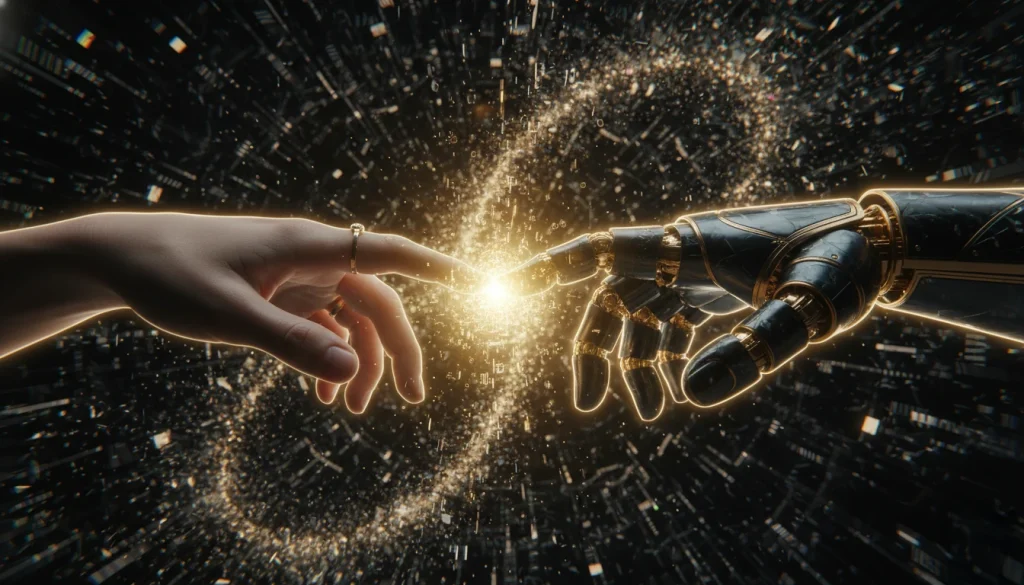
We view AI through the lens of alchemy—the fusion of base digital materials with golden human instinct. In this new workflow, the role of the creative professional shifts from “generator” to “guardian.”
We are the Guardians of Quality. We do not just “prompt and post.” The prompt is merely the opening salvo in a complex negotiation with the machine. The AI provides the raw volume, the initial sketch, the thousand possibilities. The human expert then steps in to curate, polish, fracture, and perfect.
We inject the imperfections that make something feel real. We adjust the lighting not because the data says so, but because the mood demands it. We edit the copy not for grammatical correctness, but for rhythmic impact. We ensure that every output adheres strictly to the strategic DNA of the client’s brand, something an LLM will happily ignore in favor of a more probable word choice.
This is intuitive engineering. It is the recognition that while the machine can build the structure, only the human can occupy it with a soul.
Conclusion: Architecting the Future

The initial awe of generative AI is fading, replaced by the sobering reality of implementation. Brands are realizing that access to the same tools as everyone else is not a competitive advantage; it is merely the new baseline.

The advantage now belongs to those who can bridge the Fidelity Gap.

The future of creative and digital dominance does not belong to the fastest prompter. It belongs to the deepest thinker, the sharpest eye, and the most disciplined strategist who knows how to command the velocity of the machine.

At the House of Namus, we have already made our choice. We refuse to settle for the synthetic average. We are here to architect a future where technology serves taste, not the other way around.