



Influence is fleeting; sovereignty is permanent. We explore the strategic shift required to move your brand from a participant in the market to the ruler of its own digital territory.
Introduction: The Tenant vs. The Landlord
In the digital economy, there are two types of brands: The Tenants and the Landlords.
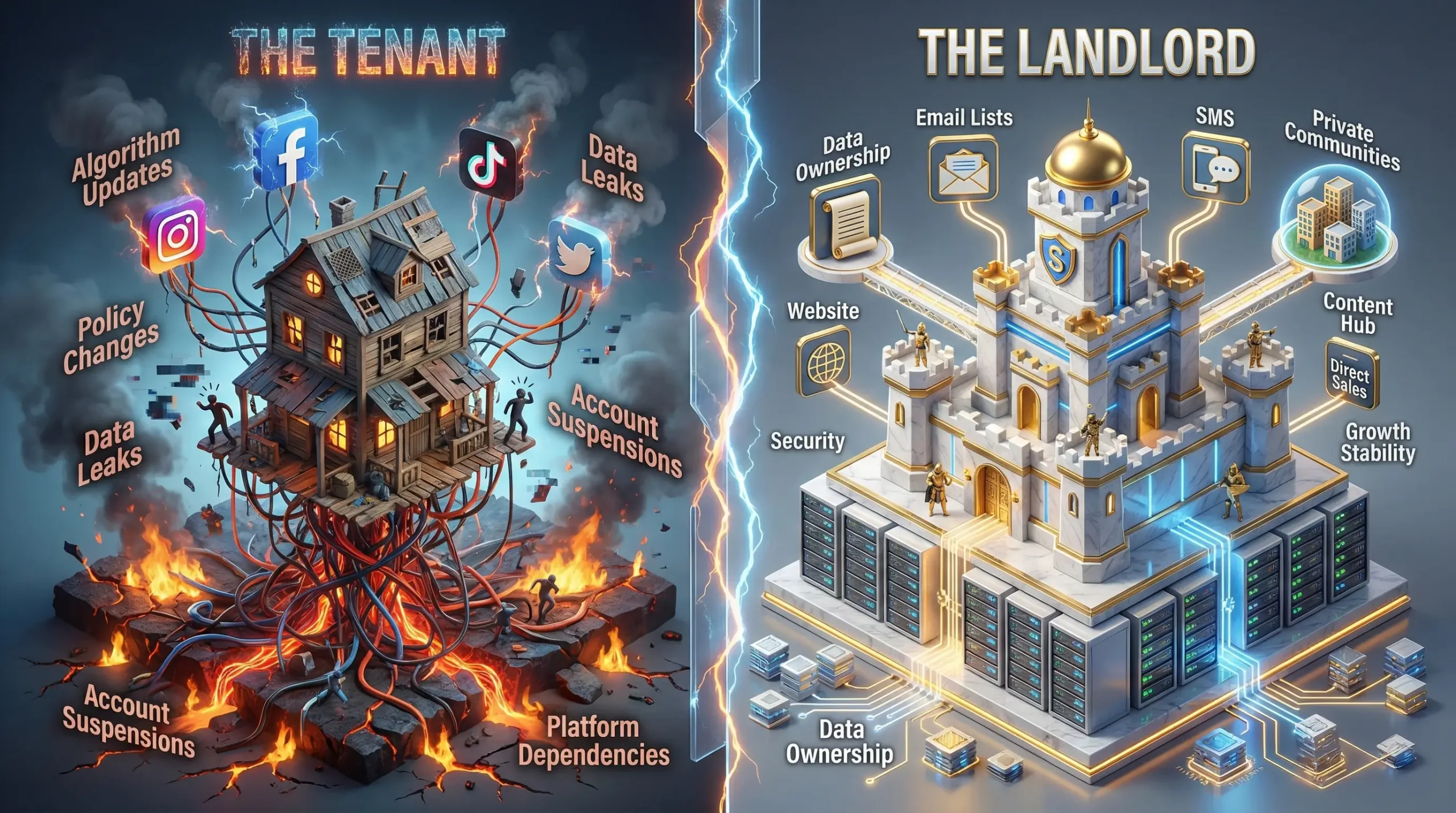
The Tenants are the vast majority. They build their entire existence on rented land. They rely on the benevolence of algorithms owned by Meta, Google, and TikTok. They chase trends, react to platform updates, and measure their success by metrics they do not own and cannot control. They are popular, perhaps even “influential” for a moment, but they are vulnerable. One algorithm update, one policy change, and their entire business model evaporates.
The Landlords are different. They do not just inhabit the internet; they own a piece of it. They use social platforms not as their home, but as embassies—outposts designed to funnel citizens back to a sovereign territory where they make the rules.
At the House of Namus, we define this state as Digital Sovereignty.
Digital Sovereignty is the transition from being a brand that competes for attention to a brand that commands authority. It is the architectural construction of a reputation so solid, and an ecosystem so self-contained, that the market conditions around you become irrelevant. You stop chasing the feed and start building the fortress.
The Failure of “Influencer” Thinking
The last decade of marketing has been obsessed with “Influence.” We track follower counts and engagement rates as if they are the ultimate currency. But influence is volatile. It is a gas—it expands quickly, but dissipates just as fast without a container.
Sovereignty is a solid. It is built on infrastructure, data ownership, and deep intellectual capital.
The mistake most brands make is confusing popularity with power. Being “viral” makes you popular; being “Sovereign” makes you powerful. A viral video can get you 10 million views, but if those 10 million people don’t enter an ecosystem you control, you have gained nothing but a dopamine hit. You are a Tenant who just threw a great party in an apartment you don’t own.
The Three Pillars of Sovereign Architecture
Constructing Digital Sovereignty requires a fundamental shift in strategy. It is not about “posting more content.” It is about engineering a structure.
This architecture rests on three pillars:
1. Intellectual Sovereignty ( The Codex)
To rule a territory, you must have a law. In brand terms, this is your Intellectual Property and your Point of View. Sovereign brands do not curate; they create. They do not follow trends; they issue manifestos.
You must develop a proprietary worldview—a “Brand Codex”—that is so distinct that competitors are forced to reference you. Think of how HubSpot owns “Inbound Marketing” or how Drift owned “Conversational Marketing.” They didn’t just sell software; they coined the language of the industry. When you own the language, you own the mindshare.
2. Visual Sovereignty (The Esthetic)
A fortress must look like a fortress. Your visual identity is the flag that flies over your territory. In an ocean of generic, template-based design and AI slop, visual fidelity is a declaration of power.
This is where High-Fidelity Design becomes a strategic asset. A Sovereign Brand never looks cheap, never looks rushed, and never looks like its competitors. The aesthetic must be so consistent and elevated that a user can recognize your content without seeing your logo. This signals to the market that you operate at a higher altitude.
3. Data Sovereignty (The Vault)
This is the most critical pillar. You cannot be sovereign if you do not own your audience.
If your primary connection to your customer is through an Instagram follower count, you are not a business; you are a user. Sovereign brands aggressively move their audience from “Rented Land” (social media) to “Owned Land” (email lists, SMS, proprietary communities, apps).
This is the Vault. It is the direct, unmediated channel to your market. When you possess Data Sovereignty, Zuckerberg cannot bankrupt you with an algorithm tweak. You have the keys to your own kingdom.

Constructing the Fortress: The Strategy of Gravity
How do you build this? You stop “pushing” and start “pulling.”
Traditional marketing is a Push strategy: shouting at strangers to look at you. Sovereign strategy is a Pull strategy: creating a center of gravity so dense and valuable that the market falls into your orbit.
-
Build the Cathedral: Instead of a generic blog, build a high-value media property (like The Editorial). Make it a destination for intelligence, not just a sales brochure.
-
Gate the Alpha: Give away your “good” content for free to build influence, but gate your best content (proprietary data, tools, frameworks) to capture data. Exchange value for sovereignty.
-
Dictate the Pace: Do not post just to feed the algorithm. Post when you have something significant to say. Silence creates anticipation. Scarcity creates value.
Conclusion: From Competitor to Ruler
The era of cheap reach is over. The digital landscape is becoming harder, more expensive, and more chaotic. The brands that survive will not be the ones clamoring for attention in the feed.
They will be the ones who built a fortress.
Digital Sovereignty is the ultimate insurance policy against market chaos. It is the refusal to be a tenant in someone else’s algorithmic reality. It is the choice to lay a foundation, build walls of high fidelity, and govern your own territory.
Stop renting. Start ruling.
