


The debate between human creativity and artificial intelligence is a false binary. The future belongs to the Alchemists: those who forge high-fidelity results by fusing human instinct with digital velocity.

Introduction: Beyond the Binary Fear
The current discourse surrounding generative artificial intelligence is paralyzed by a crude binary. On one side are the accelerationists, championing a future where human input is rendered obsolete by the sheer velocity of the prompt. On the other are the traditionalists, clinging to legacy methodologies and decrying AI output as inherently soulless derivative sludge.
Both perspectives are fundamentally flawed. They are rooted in fear rather than strategy.
The accelerationist view leads to a market saturated with low-fidelity noise—a race to the bottom where brands drown in undifferentiated content. The traditionalist view leads to operational obsolescence—a slow death by inability to keep pace with market velocity.
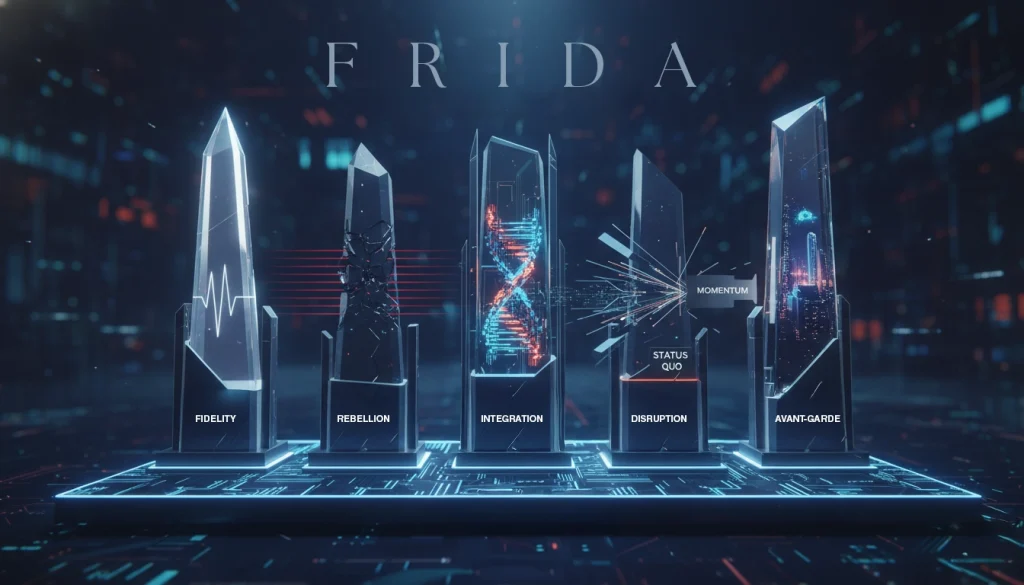
At the House of Namus, we reject this binary. We do not view AI as a replacement for the human creator, nor do we view it as a mere novelty. We view it through the lens of Integration—the third pillar of the F.R.I.D.A. Protocol.
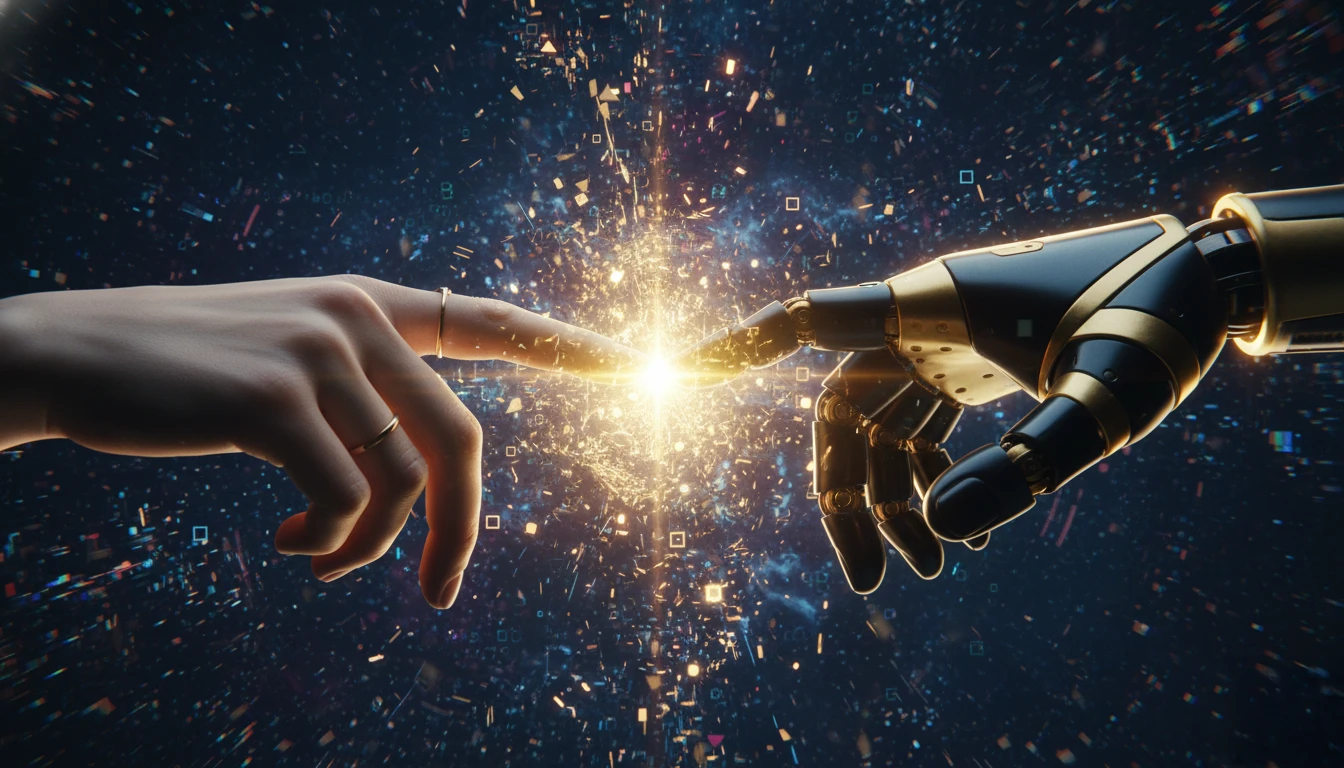
We see the relationship between human and AI not as a competition, but as a modern form of Alchemy. It is the deliberate, strategic fusion of base digital materials (data and speed) with the golden element of human instinct (taste and context) to engineer something of immense value.
The Rise of Algorithmic Fatigue
To understand why this alchemy is necessary, one must recognize the current state of the digital ecosystem. We have entered the era of Algorithmic Fatigue.
Audiences are developing a subconscious filter for raw, unedited AI generation. The mid-journey sheen, the perfectly symmetrical but empty copywriting, the generic strategic outputs—they are becoming the background noise of the internet. While AI has democratized creation, it has also commoditized average.
When everyone has access to infinite speed and volume, the only remaining differentiator is Fidelity—the nuance, the cultural resonance, and the strategic depth that an LLM cannot hallucinate on its own.
A machine can analyze ten years of marketing data in seconds, but it hasn’t lived through a decade of market shifts. It hasn’t felt the anxiety in a client meeting or intuitively understood why a specific shade of obsidian feels luxurious while another feels cheap. That lived experience is the raw material of human instinct, and it is the indispensable catalyst in the alchemical process.
Defining Digital Alchemy: The Integration Model
If the old workflow was a human laboring manually over every pixel and syllable, and the flawed “modern” workflow is a human blindly accepting whatever the machine spits out, what is the new architecture?
The House of Namus defines AI Integration as a cyclical, collaborative workflow where the human shifts from “operator” to “conductor.”
In this model, AI is deployed as a force multiplier for velocity and iteration, while the human retains absolute sovereignty over strategy, curation, and final polish. It is a workflow designed to break the speed limits of traditional production without crashing the brand’s standards.
The New Operational Architecture
Implementing this alchemy requires a disciplined reimagining of the creative and strategic process. It is not enough to simply give your team access to tools; you must engineer the handoffs between man and machine.
Here is the operational architecture of an AI-augmented workflow designed for high fidelity:
1. The Human Brief (Strategic Injection)
The process must begin with deep human intent. AI cannot generate a disruptive strategy from a vacuum. The human expert must define the parameters, the emotional goal, the market context, and the “Rebellion” angle that will separate the output from the consensus. Garbage insight in, garbage speed out.
2. The Machine Iteration (Velocity & Volume)
This is where the machine excels. We utilize generative models to explore the solution space at superhuman speed. Instead of a human designer sketching three concepts in a day, the AI generates three hundred variations in an hour. This phase is about raw volume and escaping the limitations of the blank page.
3. The Human Curation (The Taste Filter)
This is the critical juncture—the Fidelity Gap. The human expert must step back in to apply ten years of instinct to the machine’s output. This is the act of ruthless curation. We reject 99% of the generated volume, identifying the single thread, visual hook, or data correlation that possesses genuine potential.
4. The Alchemical Polish (High-Fidelity Engineering)
The selected concept is never the final product; it is merely the raw ore. The final phase is where true alchemy occurs. Human designers, writers, and strategists take the AI base and fracture it, texture it, and inject the imperfections that make it feel real. We relight scenes based on mood, rephrase copy for rhythm, and ensure the strategic architecture is sound.
Conclusion: The Dividend of Speed and Soul
The businesses that will dominate the next decade are not those with the fastest AI, but those with the best integration strategies.
By adopting this alchemical workflow, brands secure a massive competitive dividend. They gain the velocity required to be omnipresent in the modern market, but they retain the soul and fidelity required to matter.
The future of work is not human or machine. It is the sophisticated, sometimes chaotic, but ultimately powerful synthesis of both. It is time to stop fearing the tools and start mastering the alchemy.