




You achieved millions of views, the internet is talking about your brand, and your engagement is at an all-time high. So why are your sales flat? Welcome to the “WTF” moment of modern marketing.
Introduction: The Dopamine Hit vs. The Bank Statement
It is the scenario every modern Brand Director dreams of. The campaign launches. The algorithm catches fire. The view count ticks upward like a dopamine-fueled odometer—100k, 500k, 1 million. The comments section is a blur of fire emojis and “need this.” Your agency sends you a celebratory champagne emoji. You feel like a genius.
Then, a week passes. You open your Shopify dashboard, your Salesforce backend, or your Q3 revenue report.
Silence.
The needle hasn’t moved. You just spent a significant portion of your annual marketing budget to entertain the internet for 48 hours, with zero measurable impact on your bottom line. This is the precise moment where excitement turns into confusion, and confusion turns into the question that defines our marketing vertical: WTF just happened?
This phenomenon is what we at the House of Namus call The Commercial Paradox. It is the increasingly common disconnect between high-visibility digital noise and actual commercial reality.
In an industry obsessed with vanity metrics, too many agencies have confused “going viral” with “growing a business.” They are two entirely different operational objectives. If you do not understand the difference, you are not investing; you are lighting money on fire for an audience that will forget you by tomorrow morning.
The Malpractice of Vanity Metrics
The digital marketing industry has perpetrated a massive sleight of hand over the last decade. They have convinced brands that “engagement”—likes, shares, comments, video views—is a proxy for business health.
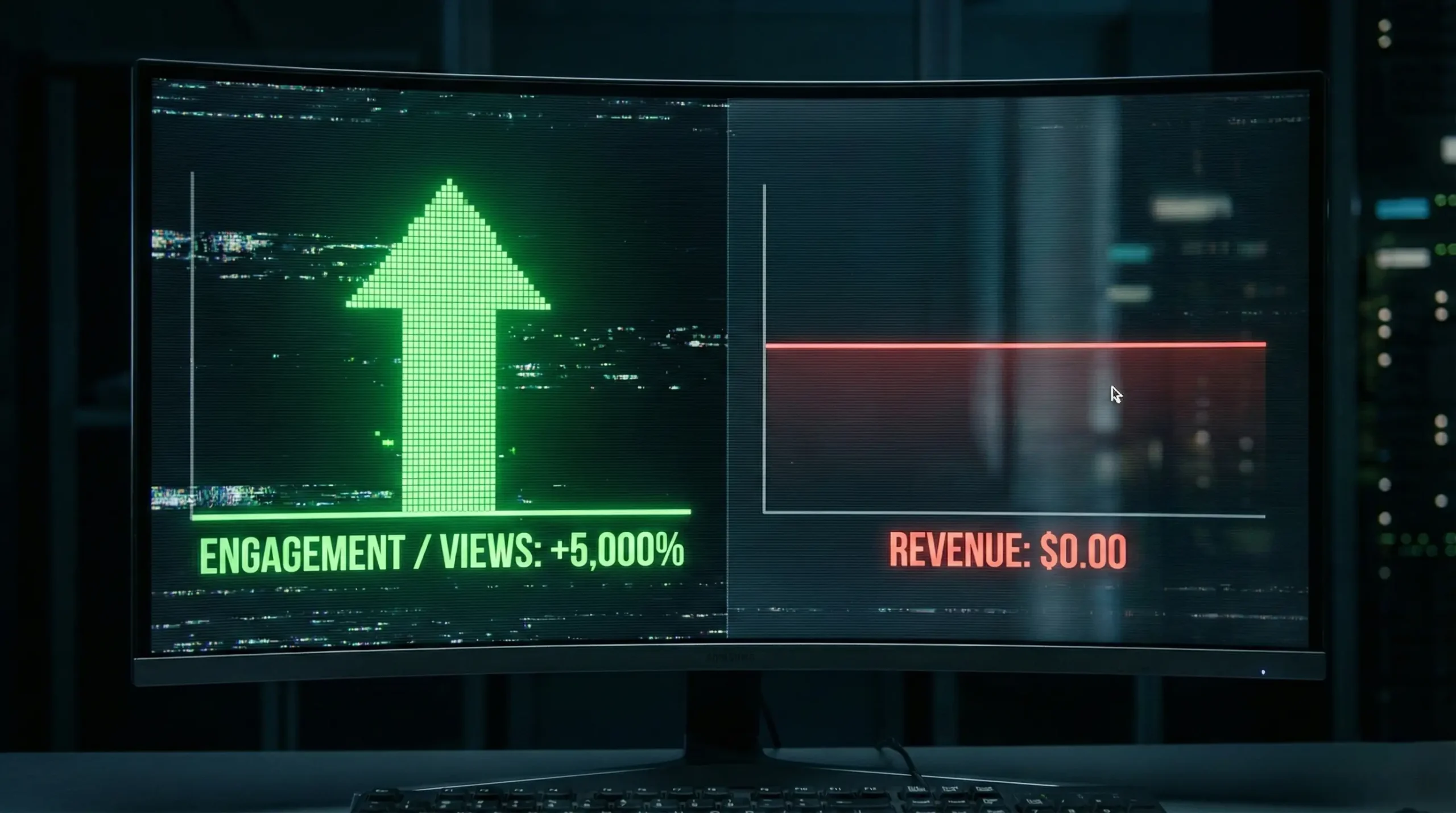
Let us be unequivocally clear: A “like” is not a lead. A view is not a sale. A comment is not cash.
These are vanity metrics. They feel good. They look impressive in a boardroom slide deck. They justify the existence of mediocre social media managers. But in isolation, they are commercially worthless.
The problem is not that viral attention is bad; it’s that attention without intention is waste. Most creative agencies are built to generate attention. They employ brilliant creatives who know how to stop the scroll. But they rarely employ brilliant commercial strategists who know what to do with the user after they stop scrolling.
They treat the symptom (low awareness) without addressing the disease (broken commercial infrastructure). They are experts at throwing a massive party at your house, but they forgot to unlock the front door, so everyone is just standing on the lawn looking at it.
The Missing Architecture: Why the Bucket is Leaking
The reason your viral campaign failed is rarely the campaign itself. The creative was likely excellent. The reason it failed is that you poured high-velocity traffic into a broken vessel.

You lacked Sales Funnel Architecture.
Before we at YNMW spend a single dollar on ad spend or creative development, we audit the entire customer journey. We look at the boring, unsexy infrastructure that actually captures value.
-
The Friction Points: When that viral traffic hit your landing page, did it load instantly? was the value proposition immediately clear above the fold?
-
The Capture Mechanism: If they weren’t ready to buy right now (98% aren’t), did you have a compelling lead magnet to capture their email?
-
The Nurture Sequence: Once you have their data, do you have an automated, high-value email sequence that educates them over three weeks, or are you just blasting them with “BUY NOW” discounts?
-
The Offer structure: Is your pricing psychology sound? Is the perceived value higher than the cost?
If these elements are not optimized, a viral campaign is actually detrimental. It exposes your operational flaws at scale. You are paying a premium to show millions of people that your buying experience is difficult.
The YNMW Methodology: Revenue Backward, Not Creative Forward
At YES NO MAYBE WTF, we operate in reverse to traditional agencies. We do not start with “What cool creative idea can we make?” We start with “What is the revenue target, and what is the mathematical pathway to achieve it?”
We build the infrastructure first. We engineer the landing pages for conversion rate optimization (CRO). We script the email sequences. We define the exact customer avatar who has the intent and capacity to purchase.
Only when this commercial foundation is cemented do we turn on the traffic hose.
When the infrastructure is sound, viral energy becomes a massive commercial multiplier. Every view enters a system designed to extract value. But without that system, viral energy is just heat dissipation—a momentary flash that leaves nothing behind but burnt budget.
Conclusion: Demanding Commercial Strategy
The era of the “brand awareness” campaign that cannot be measured is ending. CFOs are getting smarter, and they are demanding to know the ROI of the digital spend.
If your current agency is sending you reports highlighting “reach” and “impressions” without connecting those numbers to “leads generated,” “customer acquisition cost (CAC),” and “revenue,” fire them. They are entertainers, not growth partners.
Stop chasing dopamine. Start building infrastructure. The goal is not to be famous for fifteen minutes; the goal is to be profitable forever.
