




In a digital ecosystem defined by screaming volume, the most powerful commercial strategy is not to shout louder. It is to whisper to the right person. We explore the financial power of exclusion.
Introduction: The Screaming Marketplace
The current digital landscape is a screaming match. Brands are locked in an arms race of volume, pumping out thousands of content pieces, blasting generic paid ads, and flooding inboxes in a desperate attempt to capture attention.
The result is a deafening wall of noise.
For the consumer, this noise breeds apathy. They have developed “banner blindness” and subconscious filters that block out anything that feels like a megaphone. For the brand, this noise breeds inefficiency. You are paying for impressions that do not matter, clicks that do not convert, and attention that does not retain.

At YES NO MAYBE WTF, we believe that in an era of infinite noise, the ultimate luxury is Silence.
Silence does not mean inactivity. It means Precision. It means stripping away the wasted ad spend, the vanity metrics, and the broad-spectrum targeting to focus entirely on the “Signal”—the specific, high-value frequency where your actual customer lives.
The Fallacy of Reach: Why “More” is Less
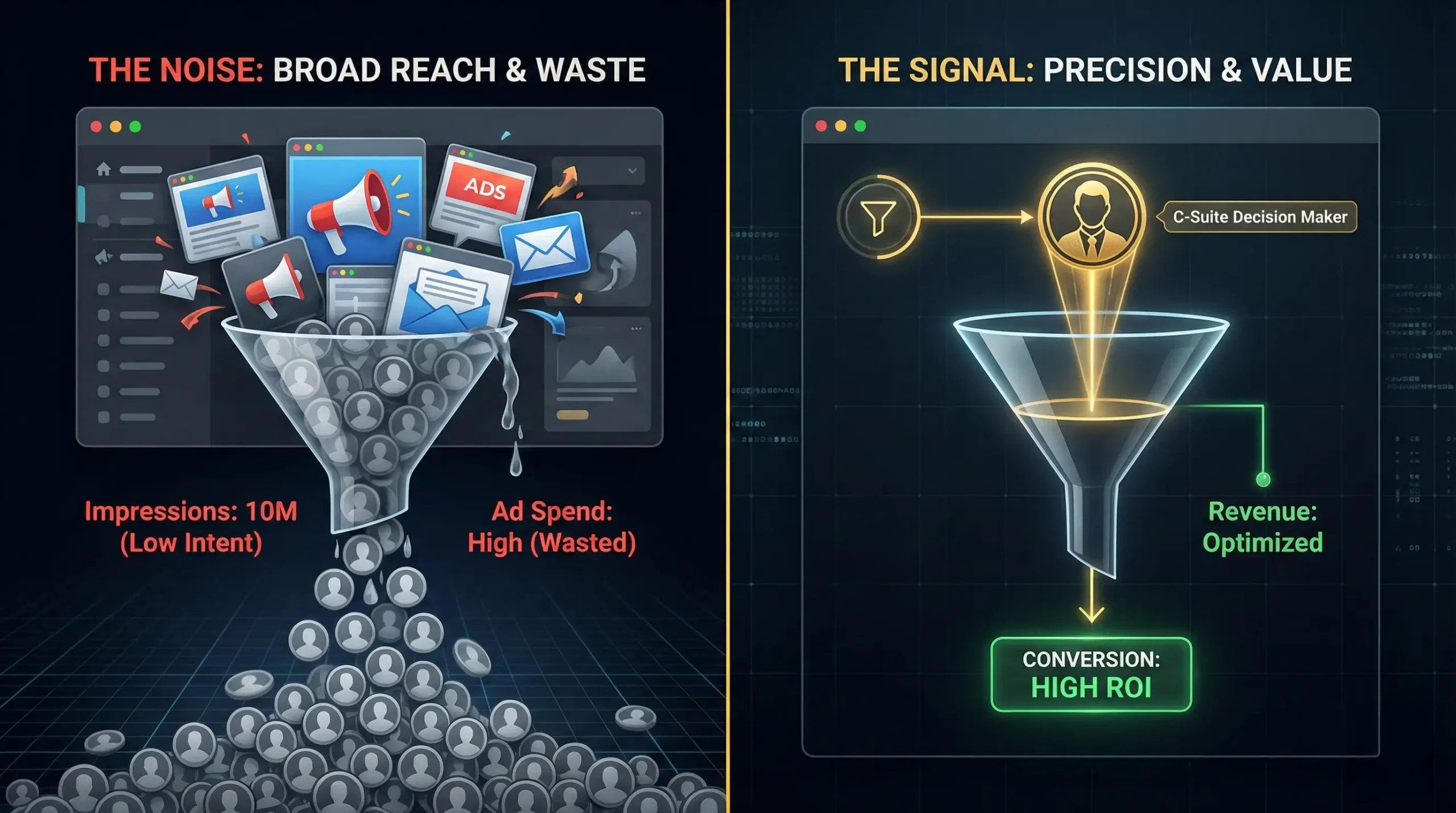
The traditional agency model is built on “Reach.” The logic is simple: If we show this ad to 10 million people, and 1% buy, we win.
This is the logic of the shotgun. It is messy, loud, and inefficient.
In the modern algorithm, “Reach” is often a liability. When you cast a wide net, you catch trash. You acquire low-intent leads who clutter your CRM, skew your data, and drive up your support costs. You pay for the privilege of annoying people who will never buy from you.
The Commercial Strategy of the House of Namus is built on the logic of the Sniper. We do not care about 10 million people. We care about the 1,000 people who actually matter. We would rather have 500 views from qualified decision-makers than 5 million views from casual scrollers.
The Strategy of Exclusion
True precision marketing is defined not by who you target, but by who you exclude.
Most brands are terrified of exclusion. They fear missing out on a potential sale. But in the luxury and high-performance sectors, exclusion is power.
-
Geographic Exclusion: Why pay for clicks in regions where your shipping logistics erode your margin?
-
Behavioral Exclusion: Why retarget a user who has bounced from your pricing page three times? They have signaled they cannot afford you.
-
Demographic Exclusion: Why show a high-ticket offer to an audience segment historically known for low average order value (AOV)?
By ruthlessly excluding the “Noise,” we artificially inflate the “Signal.” We concentrate the budget entirely on the highest-probability targets. This drastically lowers your Customer Acquisition Cost (CAC) and creates a self-reinforcing cycle of quality.
High-Fidelity Targeting (The ABM Approach)
Once we have cleared the noise, we deploy High-Fidelity Targeting. In the B2B space, this is often called Account-Based Marketing (ABM), but the philosophy applies to B2C luxury as well.
We do not target “Men, 25-45.” We target specific behaviors, specific intent signals, and specific psychographic profiles.
-
We track who is reading your competitor’s pricing page.
-
We identify which users are engaging with “luxury aesthetic” content across platforms.
-
We use first-party data to build “Lookalike Audiences” based only on your top 1% of spenders (your Whales), ignoring the average customer entirely.
This is the “Whisper.” We are delivering a highly relevant, highly specific message to a user who is already primed to receive it. Because the targeting is so precise, the creative does not need to scream. It can simply state the value proposition. The resonance comes from the relevance, not the volume.
The Financial Dividend of Silence
The result of this approach is a massive improvement in Return on Ad Spend (ROAS).
When you stop paying to talk to strangers, you can afford to spend more to talk to prospects. You can bid higher on the keywords that actually convert. You can produce higher-quality creative for the channels that actually drive revenue.
You move from a model of “High Volume / Low Conversion” to “Low Volume / High Conversion.”
Conclusion: The Signal is the Strategy
The brands that will win the next decade are not the ones with the biggest megaphones. They are the ones with the sharpest aim.
Stop trying to be heard by everyone. Start trying to be understood by the right one. In a world of noise, the most profitable sound is the quiet click of a qualified purchase.
